
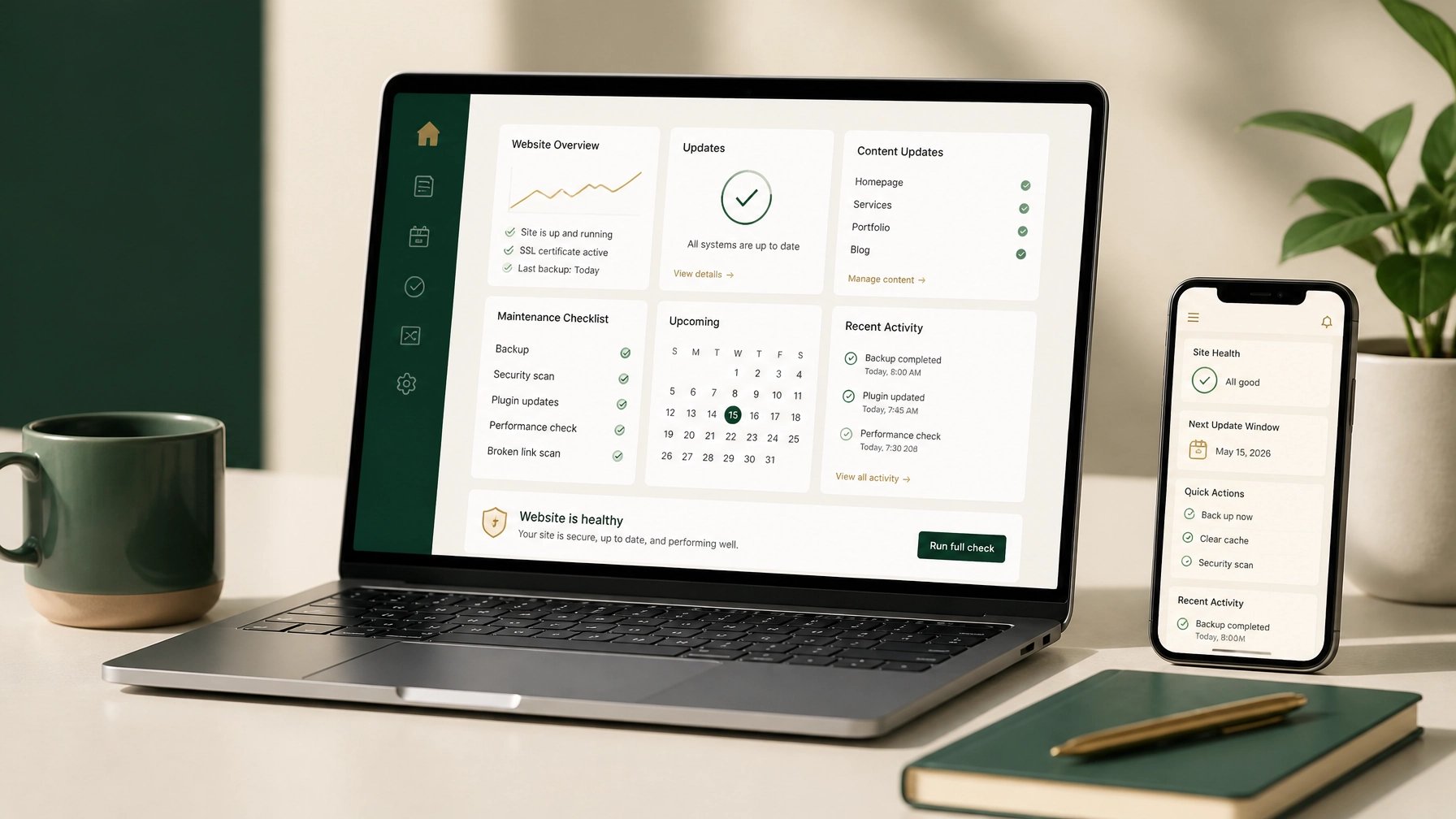
A small business website doesn’t need a complete redesign every few months. It does need regular attention.
For most small businesses, a practical schedule looks like this:
- Immediately: Update information when it changes.
- Monthly: Review important pages, forms, links, and basic technical details.
- Quarterly: Check performance, search visibility, and the customer journey.
- Annually: Complete a broader content and website review.
- Every 2–3 years: Consider a larger design or structural refresh if the site no longer represents the business well.
The right schedule depends on how often your services, pricing, staff, products, or events change. The goal isn’t to make changes for the sake of activity. It’s to keep your website accurate, professional, and helpful to the people deciding whether to contact you.
Update important information right away
Some website updates shouldn’t wait for a monthly review.
If something affects a customer’s ability to contact you, understand your services, or visit your business, update it as soon as possible. This includes:
- Business hours
- Phone numbers and email addresses
- Service availability
- Pricing and package details
- Team member information
- Address and location details
- Booking links
- Seasonal promotions
- Event dates
- Service areas
An outdated phone number can cost you a lead. An expired promotion can make your business look neglected. An old team page can create confusion for people who are trying to understand who they’ll be working with.
A simple rule helps: if the information has changed in your business, it should change on your website.
Review the site every month
For many local service businesses, monthly website maintenance is a sensible baseline.
You don’t necessarily need to publish a new article every month. You do need to look at the site with fresh eyes and confirm that it still reflects the business accurately.
A monthly review should include:
- Reading the homepage and service pages
- Testing every contact form
- Clicking phone and email links
- Checking the site on a mobile phone
- Confirming business hours and location details
- Reviewing current offers and announcements
- Checking that important links still work
- Looking for obvious spelling or formatting issues
This process usually takes less than an hour for a small site. It can prevent small problems from becoming customer-facing issues.

Add fresh content when it serves a purpose
Fresh content can help your website stay useful, but you don’t need to publish just to meet an arbitrary schedule.
For most small businesses, one helpful update every month or so is enough. Depending on your business, that update might be:
- A new blog post
- A frequently asked question
- A recent project or case study
- A customer testimonial
- A seasonal service reminder
- A new team member introduction
- An updated service explanation
- A short announcement about your business
The best content answers questions your customers already have. A contractor might explain how to prepare for a remodeling project. A clinic might publish information about a common service. A realtor might share a practical guide for preparing a home for sale.
This kind of content can support local search visibility and give prospective customers another reason to trust your expertise. Google also recommends using Search Console to understand how your pages appear in search and which queries bring people to your site.
The focus should be usefulness, not volume.
Check technical details monthly
Website maintenance for small business owners doesn’t have to involve complicated technical work. You can start with a few simple checks.
Each month, confirm that:
- The site loads correctly.
Open the main pages on a desktop computer and a mobile phone. - The contact process works.
Submit your form and confirm that the message arrives at the right email address. - The main buttons work.
Test links for calling, booking, requesting a quote, viewing a menu, or getting directions. - The site is secure.
Confirm that the site uses HTTPS and that there are no browser security warnings. - The layout still looks right.
Pay attention to menus, images, buttons, and text that may look crowded or misplaced on smaller screens.
Technical problems can appear after a platform, browser, plugin, or integration changes. That’s why monitoring matters even when you haven’t edited the website yourself.
Complete a deeper review each quarter
Every three months, take a closer look at whether the website is helping people take the next step.
Review:
- Which pages receive the most visits
- Which pages generate calls, form submissions, or bookings
- Whether visitors can quickly understand what you do
- Whether your most important services are easy to find
- Whether your calls to action are clear
- Whether your pages still match your current business goals
- Whether any old pages should be updated, combined, or removed
You don’t need to become an analytics expert. Look for practical patterns.
If people visit your service page but rarely contact you, the page may need clearer information or a more visible next step. If visitors leave quickly from the homepage, the message may not explain your value clearly enough. If one service receives most of your inquiries, make sure it’s easy to find from the main navigation.

Refresh trust signals twice a year
People use your website to decide whether your business is active, established, and dependable. Trust signals should be reviewed at least twice a year.
Consider updating:
- Testimonials
- Project photos
- Portfolio examples
- Team photos
- Certifications
- Awards
- Client or community highlights
- Frequently asked questions
Recent examples are especially useful for professional services, contractors, salons, clinics, restaurants, and real estate businesses. They show visitors that you’re currently serving customers: not simply relying on an old website.
If your business has completed several strong projects since the site was built, adding two or three examples may do more for credibility than changing the entire design.
Plan a full review once a year
An annual review is a good time to ask whether your website still supports the business you have today.
Your business may have changed since the site was first created. You may offer new services, serve a different area, have a new ideal customer, or want more calls instead of form submissions.
Review the following:
- Main website message
- Services and pricing
- Navigation
- Photos and visual identity
- Contact and inquiry process
- Search-focused page titles and descriptions
- Accessibility basics
- Mobile experience
- Hosting and domain details
- Privacy and security requirements
This doesn’t always lead to a rebuild. Often, a focused content refresh is enough.
A professional website for a small business should be maintained according to business needs: not changed simply because a certain amount of time has passed.
Know when a redesign makes sense
A redesign is different from regular website maintenance.
You may need a larger refresh when:
- The site is difficult to use on mobile
- The design no longer reflects your business
- Your services have changed substantially
- The navigation has become confusing
- The website is slow or difficult to update
- Your current platform limits important features
- The site no longer generates the inquiries you need
- Your competitors present a noticeably clearer experience
Many small business websites benefit from a larger design or structural review every 2–3 years. Some can go longer when the content, technology, and customer experience remain strong. Others need attention sooner because their business changes quickly.

Start with a manageable routine
You don’t need to spend every week working on your website. A simple routine is usually more sustainable:
Every month
Review the main pages, test forms and links, and make small content and time-sensitive announcement updates when needed.
Every quarter
Review performance, search visibility, navigation, and the pages most important to your business.
Every year
Complete a broader content, technical, and customer experience review.
Every 2–3 years
Decide whether the design, platform, or structure needs a larger refresh.
If you’re starting with a new small business website package, build this routine into your launch plan from the beginning. A clear site structure, mobile-responsive design, basic on-page SEO, and reliable hosting give you a strong foundation. Ongoing attention keeps that foundation useful.
At First Look Web Co., our standard website build includes up to five custom-designed core pages, mobile responsiveness, basic on-page SEO, contact and map integration, launch checks, and the first 12 months of hosting. We also provide practical recommendations for keeping the site active after launch. You can review the standard services, see transparent pricing, or contact us with a question.
For businesses that prefer ongoing help, our optional Ongoing Content & Marketing service includes monthly website updates when needed, along with content and marketing support. It’s a separate monthly option, so you can choose the level of help that fits your business.
The main point is simple: update your website whenever important information changes, review it monthly, and take a deeper look each quarter. Regular maintenance helps your site stay accurate, trustworthy, and easier for customers to use: without turning website upkeep into a full-time job