
If you’re researching small business website cost, you’ll find a wide range of answers.
A basic DIY website may cost less than $1,000 for the first year. A custom agency website can cost $8,000 to $15,000 or considerably more. For many small businesses, a professionally built website falls somewhere between those extremes.
In 2026, a typical professional small business website often costs $3,000 to $8,000 upfront, depending on the designer, the number of pages, the amount of custom work, and the features involved.
However, not every business needs a large agency project. A focused five-page website can provide a professional online presence without the cost and complexity of a much larger build.
The short answer
Here are the common price ranges:
These are general ranges, not fixed rules. The right price depends on what your business actually needs.
For broader industry context, guides from GoDaddy and Elementor also show how widely website pricing can vary by scope and build method.
What does a professional website include?
A professional website should do more than look attractive. It should explain what you offer, help people trust your business, and make it easy for the right visitors to contact you.
For many small businesses, that means:
- A clear homepage
- An about page
- Services or products information
- A contact page
- Location, hours, or service-area details
- Mobile-friendly layouts
- Basic search engine optimization
- Contact forms and inquiry options
- Professional copy and visual structure
- Secure hosting and launch support
A contractor, clinic, salon, restaurant, or consultant may not need dozens of pages. They usually need a clear, useful website that answers common questions and guides visitors toward the next step.
That’s why page count matters. A five-page service website and a 50-page membership platform are both “websites,” but they are entirely different projects.
How much does a five-page website cost?
A professionally designed five-page website can cost anywhere from approximately $1,500 to $8,000, depending on who builds it and what’s included.
Lower-cost projects may use a template with limited customization. Higher-cost projects may include brand strategy, custom illustrations, extensive copywriting, photography, advanced SEO, or specialized functionality.
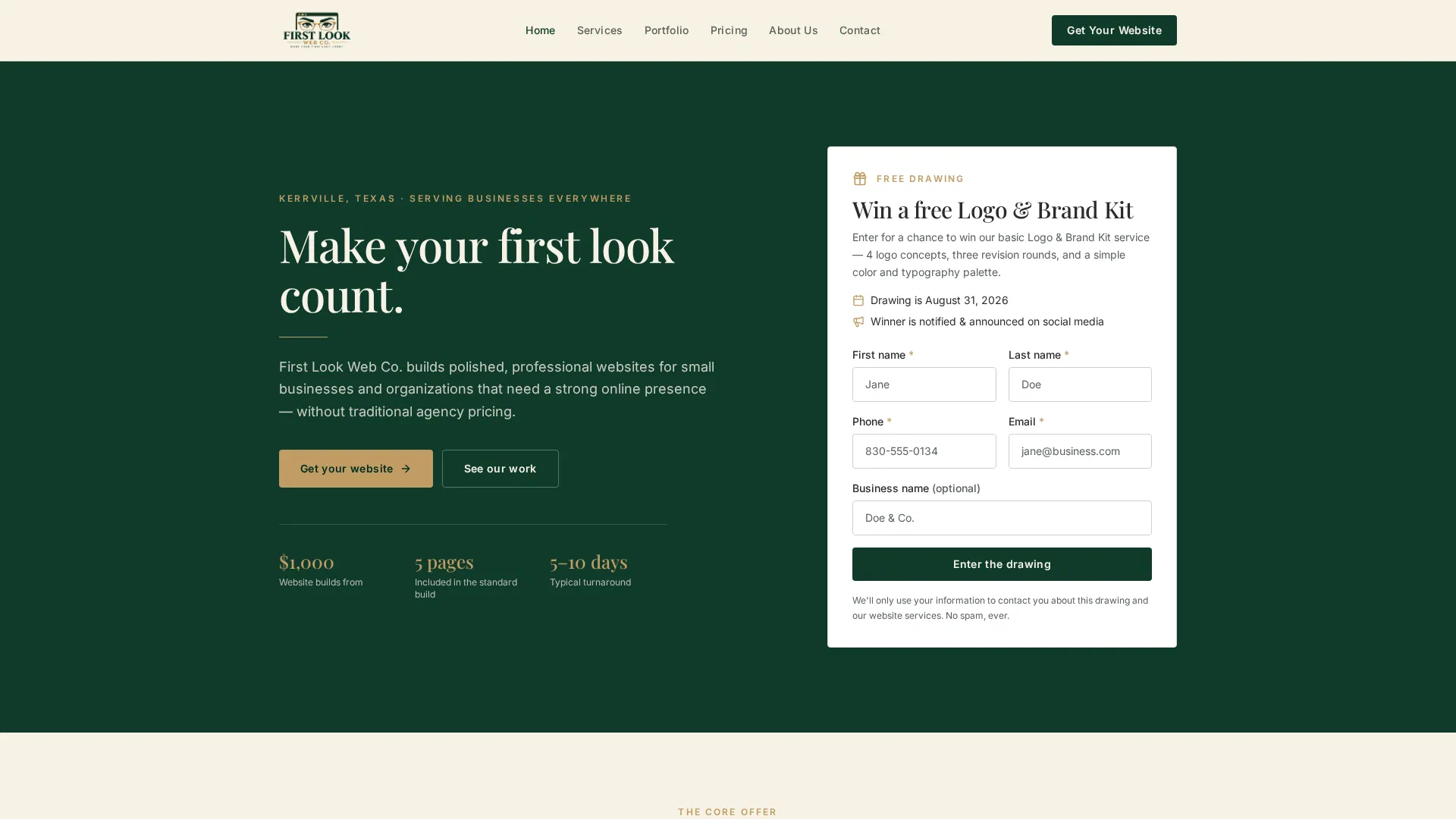
At First Look Web Co., our standard website build is designed for small businesses that need a polished online presence without traditional agency pricing.
The standard price is:
- $1,250 for a private standard website
- $1,000 with the portfolio participation discount
Both options include the same website build. The $250 discount is available when we have permission to feature the finished website, business name, link, or screenshots in our marketing.
The standard build includes:
- Up to five custom-designed core pages
- Mobile-responsive design
- Professional copywriting and content assistance
- Basic on-page SEO
- Contact or lead inquiry form
- Social media links
- Google Maps integration when appropriate
- Basic accessibility considerations
- Domain connection and launch configuration
- Up to three initial SEO-oriented blog posts when appropriate
- Two standard revision rounds, plus a third just in case
- The first 12 months of hosting
- Launch and performance checks
- A post-launch website growth checklist
You can review the complete scope on our website pricing page or see what’s included in the standard website service.
What affects the price?
Website pricing usually changes for a few practical reasons.
Number of pages
Every page requires planning, layout, writing, design, and review. A five-page website is much simpler to manage than a website with 25 service pages, location pages, and resource sections.
Custom design
A custom visual design takes more work than installing a theme and replacing the text like most DIYers use. It also gives you more control over how your business is presented.
The goal isn’t to add decoration for its own sake. The design should make your services easier to understand and your business easier to trust.
Copywriting and content
Many business owners know their services well but don’t have time to turn that knowledge into clear website copy.
Professional writing help may be included in a website package or priced separately. It can cover service descriptions, homepage messaging, calls to action, FAQs, and basic SEO-focused content.
You’ll still review the content for accuracy. Your website should sound like your business and reflect what you actually provide.
Special features
Standard contact forms and map integration are usually straightforward. More advanced functions can increase the cost.
Examples include:
- Online booking systems
- E-commerce stores
- Membership areas
- Customer dashboards
- Advanced calculators
- Custom databases
- MLS or IDX real estate integrations
- Large product catalogs
- Custom software connections
These features aren’t automatically a problem. They simply require more planning, testing, and ongoing support. At First Look, projects that substantially exceed the standard scope are quoted separately so the price is clear before work begins.
Branding and photography
If you already have a usable logo, colors, photos, and business information, the project can move more efficiently.
If you need a basic visual foundation, First Look offers an optional Basic Logo & Brand Kit for $99. It includes four initial logo concepts, three revision rounds, a simple color palette, typography guidance, and final logo files for web and basic business use.
Professional photography, video, or a complete brand identity are separate services and may add to the overall cost.
What are the ongoing website costs?
The build price is only one part of the total cost. You should also ask about hosting, domain registration, maintenance, and future updates.
Common ongoing costs include:
- Domain registration: commonly $10–$35 per year
- Website hosting: often $15–$150 per month, depending on the provider and support
- Maintenance: approximately $20–$300 per month for updates, monitoring, and support
- Content marketing: priced separately based on frequency and scope
At First Look, the first 12 months of website hosting are included in the build. From year two, hosting is $199 per year. This covers website publication, secure hosting with SSL, and reasonable technical administration. Your domain registration remains yours.
Ongoing content and marketing support is also available for $349 per month. That option includes two SEO-focused blog posts per week, five days of social media content creation and scheduling on specified accounts, and monthly website updates when needed.
You don’t have to purchase ongoing marketing support. You can manage your own content and use the website growth recommendations provided after launch.
How long does a website take to build?
A small business website can take anywhere from a few days to several months.
DIY projects often take longer than expected because the business owner is managing the writing, design, setup, revisions, and technical details alone. Larger agency projects may involve multiple planning and approval stages.
First Look’s typical turnaround is 5–10 business days after receiving the materials and information needed for the build.
The process is straightforward:
- Discovery: We discuss your business, customers, services, and website goals.
- Deposit and materials: A $250 deposit reserves production time. You provide your logo, photos, hours, services, and key facts.
- Design and build: We write, design, and build the pages.
- Review and revisions: You review the website and send one consolidated list of requested changes per revision round.
- Launch: After final approval and payment, we connect your domain and publish the site.
A defined process helps keep the cost and timeline predictable.
Is affordable web design right for your business?
Affordable web design for small business doesn’t mean removing every important part of the process. It means keeping the scope focused, reducing unnecessary overhead, and being clear about what is and isn’t included.
A standard five-page website may be a good fit if you need to:
- Establish a professional online presence
- Explain your services clearly
- Give customers a reliable way to contact you
- Improve trust when people search for your business
- Replace an outdated or incomplete website
- Launch without a long agency timeline
A larger project may be more appropriate if you need e-commerce, a membership system, advanced booking, custom software, or a large content structure.
The right first step is to define what the website needs to accomplish. You don’t need to pay for features your customers won’t use.
What should you ask before hiring a web designer?
Before agreeing to a website project, ask:
- How many pages are included?
- Is copywriting included?
- Is the design custom or template-based?
- How many revision rounds are allowed?
- Is hosting included?
- Who owns the domain?
- What happens after launch?
- Are forms, maps, and basic SEO included?
- Which features cost extra?
- What is the expected timeline?
- When is the final payment due?
A clear answer to these questions can prevent surprise charges and misunderstandings later.
At First Look, the scope is documented before work begins. Anything outside the standard package is discussed and priced separately before the work starts.
The bottom line
So, how much does a small business website cost in 2026?
For a DIY website, you may spend less than $1,000 in the first year. For a professionally built small business website, the broader market commonly falls between $3,000 and $8,000, with larger agency projects reaching well beyond that range.
A focused professional website can cost less when the scope is clear and the process is efficient.
First Look Web Co. offers a standard five-page website for $1,250, or $1,000 with the portfolio participation discount. Hosting is included for the first year, and the project typically takes 5–10 business days once we have your materials.
If you’re unsure what your business needs, you can contact First Look with a brief description of your goals. We’ll help you understand what fits the standard package, what would be optional, and what should be quoted separately.